

Right On Time
TL:DR I bought a house in my hometown

I was the child of people who went places.
By the time I was born, my parents had lived in four states and six countries between them. They spoke multiple languages. They were accustomed to the navigation of unfamiliar cities, of trains and airplanes and roads, of learning to communicate and adapting when you cannot, of starting over with jobs in new places, of the formative power of being a stranger in a strange land. And so it is no surprise that I have interpreted going places as a fulcrum of success and fulfillment. It was a streak of upper-class priorities in my financially lower-class childhood. I studied abroad in college. I went on service trips. I visited friends all over the map. For grad school, I moved from Indianapolis to Chicago – the trajectory of the aspiring young thing! You leave your smaller city and move to a bigger one because you have Potential!
When I began dating my now-husband, it was with the knowledge that we would continue being the going-places type. Cody went to medical school on a scholarship through the US Navy, which, among other things, is an institution that hires doctors: in exchange for his tuition, he would get through medical school in this one city, and then through residency in a different one, and then he would go to work for a number of years on a military base, or potentially on multiple bases, or potentially on bases in between periods of deployment to provide medical care.1
By the time he was finishing medical school in Indianapolis I truly wanted to get out of my hometown and never live there again. I felt claustrophobic, trapped, perceived, exhausted. I thought we might be leaving forever. I roved the map in my brain, calling to mind cities that were not Indianapolis, where one might hypothetically settle. I could live in Atlanta, I thought. I could live in Chicago again. I could live in New York (though my husband, to be fair, could not).
On residency match day – a nationwide ritual in which graduating medical students all simultaneously find out where they will spend the next three to seven years, like a deck of cards shuffled up and strewn on the floor – our card skittered us over to Memphis, Tennessee. This is where we live now. It is a place that has been very good to us. I got a day job that is not my passion but suits me. Cody in turn got really good at his job, gaining a level of experience that places him in the top tier of emergency physicians nationwide. We have both settled into ourselves in this phase of our careers, our relationship, our values, our interests. And now, this is the place we are about to leave. The next portion of Cody’s job assigned us to North Carolina, which is an outcome about which I have mixed feelings. But we are the going-places type, and we will adapt to this next place.
However, in the past year, while we figuratively twiddled our thumbs waiting for the powers that be to tell us where we must live, something else happened.
Some friends of ours at home decided to sell their house and pack up to move closer to family in another state. And, one night as I walked past the couch to the bedroom, my partner looked up and said “hey . . . what if we bought their house?”
And without a single hesitance in my spirit I said “yes.”
* * *
The years away have effected a change in my attitude toward my hometown.
I do not feel defined by the place where I grew up, in a way I uncomfortably did when I still lived there and wanted to leave. I have at times felt an embarrassment regarding the Midwest, the sense that choosing to live there makes a person by definition hokey and unambitious. (But actually, even if I did believe that, it does not follow that being hokey and unambitious is a cardinal sin. There are manifold worse things one could be, like a billionaire, or a racist, or someone who does not respect either old trees or young children.) True, it is not sexy to be from Indianapolis. There is perhaps no unsexier place. It has absolutely no glamor at all, and when a comedian I follow on the internet mentioned coming to town and asked for recommendations for what to do in town, I found myself thinking, damn, I really don’t know.
But you have to live in a place.
You have to live somewhere, as the moving truck man told writer John Green, when he moved back to Indianapolis in 2007. He tells the story in an essay about the city, now collected in his book The Anthropocene Reviewed – an essay I have never once read through without tears rising to my eyes, and I have read it many, many times. (You can listen to an earlier version of this essay in its radio form, here.)
You have to live in a place, and, regardless of its sexiness or glitz, you may come to feel uniquely compelled by the place you know best. I think it is so funny when people express loyalty to their hometowns through the lens of it being the best place. No place is the best place; that is not even a metric that makes sense at all. But you are allowed to love the one that formed you.
The same goes for sports teams, universities, and friend groups.
The same goes for religions. I no longer believe in the absolutism of the religion that formed me, the supremacy of it both as True and as the best way to conduct a human life. But it is the one that formed me nevertheless. I have read and reread Aminatou Sow’s reflections on Ramadan and Eid this year2, comforted to no end by her playful engagement with the gravitational pull of the religion that raised her – not because it is the best or truest one, but because it is the one endowed upon her by accident of birth. Her relationship with Islam is far less about God or Mohammed than it is about her mother. And, a little behind her mother but still ahead of Mohammed, it is also about her West African heritage, her commitment to an ethic, a sense of smallness in a universe that is big.
I love the lucidity of Aminatou’s perspective, it’s anti-angst. I appreciate the reminder that my human angst would not be salved by a different religion, any more than my ambivalence about my midsize midwestern hometown indicates that I would be more fulfilled living somewhere else instead. There is not a supremacy to places any more than there is to religions. I am shedding the skin of the bright young thing who supposed that I’d probably better move to The Big City . . . just so that people would know I am the kind of person who would (??).
No. I am not special. This place is not special. I feel so much less defined by this town than I did when I was twenty-five, but I feel more inspired to love a given place. And this is, after all, the place that life gave me to love.
Indianapolis is the town where several of my closest friends live. Where they, too, have now become professional adults who own houses and seem inclined to stay awhile, barring the collapse of all civil rights in middle America. As a woman in my thirties who still cannot decide whether/when to have a child, I at least know that I would prefer to do so in this place. After all, this is not only the town where I was a child, and the town where people I love are already parenting, but also the town where I have spent the most time as a caregiver. When I envision the logistics of childhood, I envision them in Indianapolis. There is something in the devil you know.
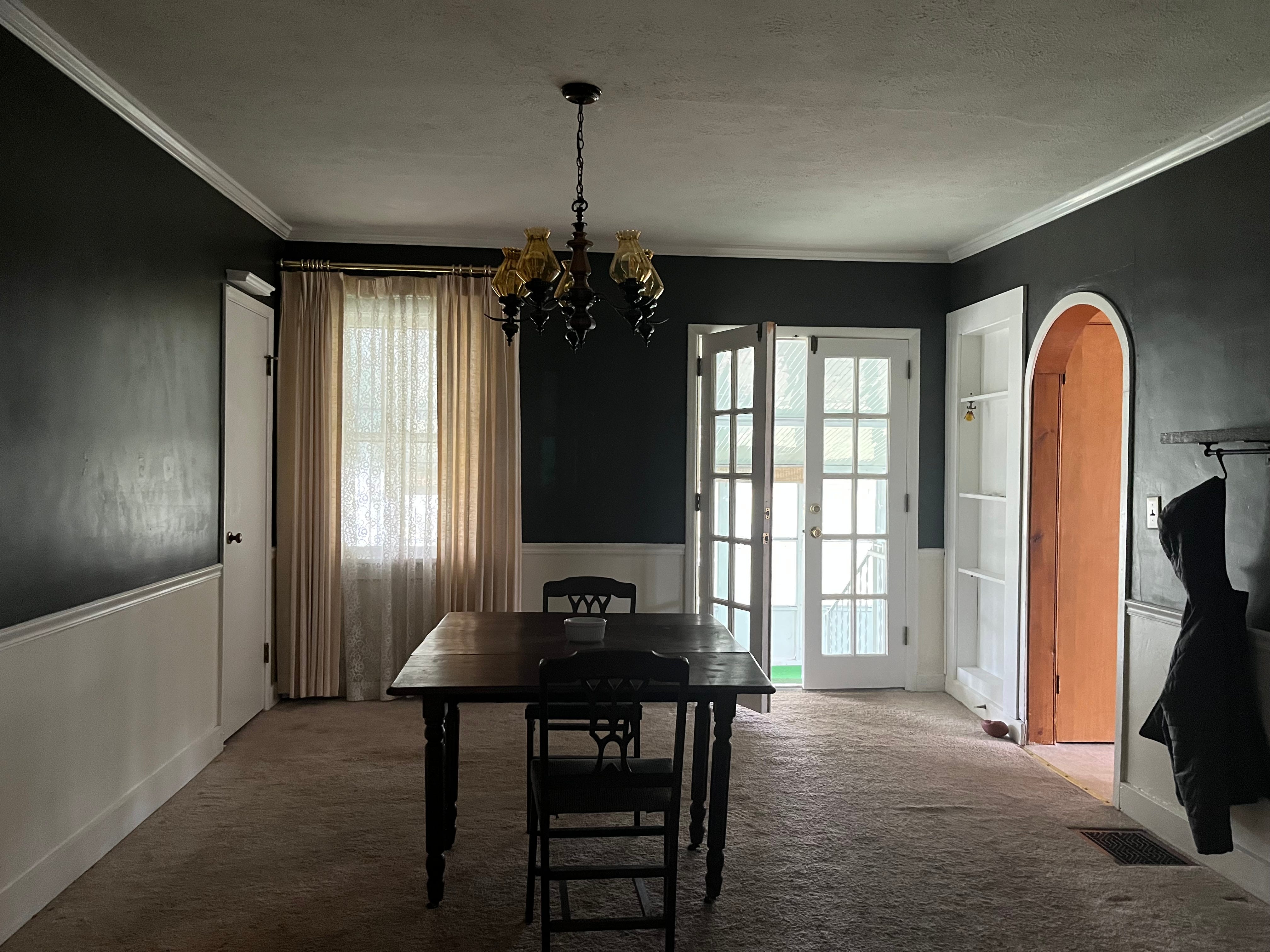
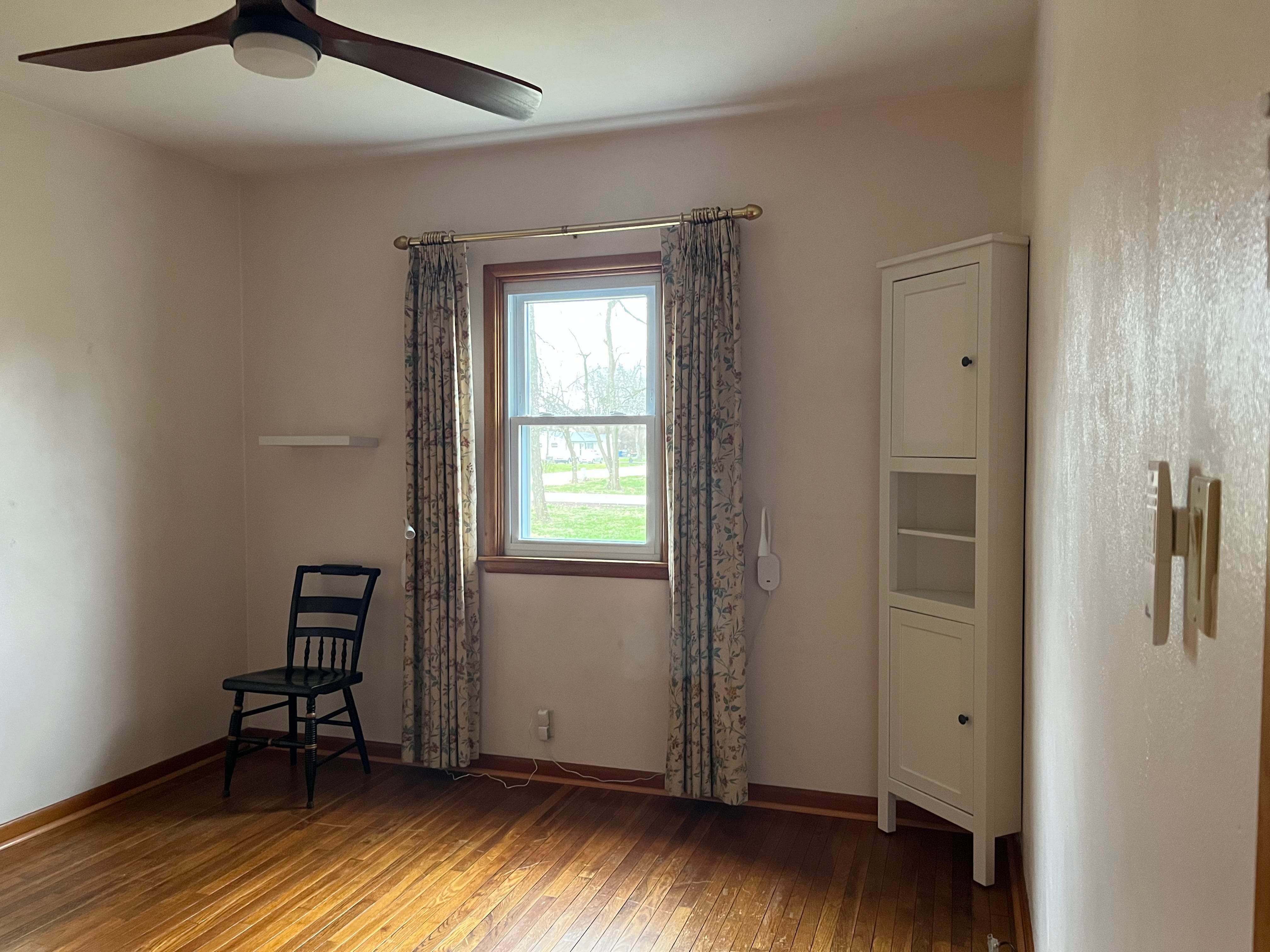
Slowly, I realized how my vision for my life and home overlayed quite well on this exact house in this exact town. I want to live in an old house with nooks and crannies but also abundant windows and, if possible, a sun room. My partner wants a big plot of land, and I want a garden. I want space for a studio. I want rambling rooms – no to open concept, multi-purpose nonsense. I want to be close to my friends, close enough to run errands or help with chores or share a meal on a weeknight. I want a city resourced enough to have lots of hospitals and universities, a robust public library system, parks, coffee shops, museums, and theaters. And yet, I also want trees and birds. I want neighbors. I want space for guests.
This place provides, improbably, all of those things.3
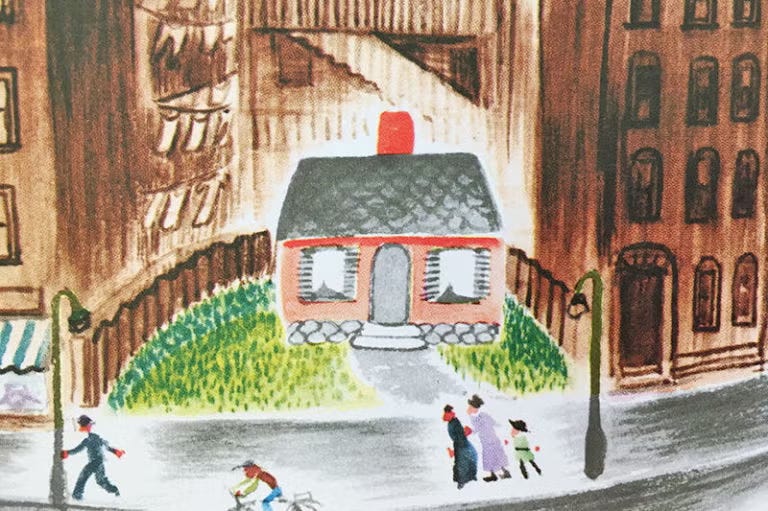
The housing market in this country is in some ways out of control, but I am here to tell you that there are select pockets in midwestern cities where you can find forgotten old houses on forgotten old plots of land around which the sprawling city has scrabbled its way out of the ground over the course of a hundred years.
I know they exist, because one of them is mine.
* * *
I do not know how to buy a house. I hardly envisioned myself as a person who would ever own one.4 The idea arrived in early November, and it took us until March 21st to close the deal. It appeared to come crashing down multiple times. Buying a house in 2025 is no small feat. If you cannot ever buy a house; if you can only buy one with help from family; if you cannot get help from family but can qualify for a first-time-buyer assistance program; if you can do none of the above but are scrimping and saving regardless, you are normal. If you own a house that you bought in a prior decade, god damn I hope you get to live in it forever and make a killing on it when you are old. We would never have been able to buy this one without a true confluence of luck, generosity, patience, and stubbornness.
And so, on what I thought was fittingly the first day of spring but was actually the second day of spring, we signed a mountain of papers and the house became our own. We camped out inside it on an air mattress, and ate takeout pizza with our friends. We started talking about projects – taking up some old carpet here, what to plant there. We clocked which trees by the driveway were getting ready to bloom, and how we would not get to see them this spring but would in lots of future springs to come. Springs ad nauseum. Springs galore.
Because, of course, after the commemorative weekend we got back into our car and came back to our current apartment in this different state where we actually live. But now we have a secret, like a mother who has not yet told people about her pregnancy, but knows it is happening. Now, when we have to reckon with moving for this next job and the selling of our souls and the starting over of our habits, when our friends back home are having parties without us, when I feel uninspired by my boring rented home with its dim light and soulless affect, when I consider if or when to quit my day job, when I bemoan the long travel distances required to see anyone I love – it is now with a caveat. An asterisk, a safety net, a promise. Yes, and, we have Indiana. Yes, and, we have a house.
Yes, and, we have a future.
* * *
As we told our friends about the house – which, to be clear, we will not be able to live in full-time for several years yet – more than one of them said to me, “I thought you never wanted to go back to live in Indiana.”
And I have said, “I know. I didn’t. And now my wants have changed.”
Life is long, and there is something to be said for the swell of universal human experience, patterns writ large across each lifetime. I like the feeling that people pretty much do all the same stupid stuff. I still don’t know if I want a baby, but I respect the universality of it, the thought of being awake at night with your own baby just like billions of other mothers have been awake, too, under the same night, lit by the same moon, crouched in desperation on the same planet as it spins into another morning. We are not special, neither uniquely depraved nor singularly enlightened. We are all just puttering around repeating the behaviors of our ancestors as if we invented them. Starting fights and making up. Falling in love and growing old. Raising children and letting them go. Creating and building. Losing and grieving. Setting out to die on some hill and then, slowly and with cramps in our legs, climbing back down.
In John Green’s essay on Indianapolis that makes me cry, he evokes the words of Kurt Vonnegut, who said that the most daring thing young people could do with their lives in the decades to come was “to create stable communities in which the terrible disease of loneliness can be cured.”
I am choosing not what I think is the best city, nor even, in some abstract algorithmic way, the best one for my tastes or personality. But I am choosing one where I have a shot at stable community, at the lifelong maintenance work of alleviating the human disease. And to do that, I am returning home.
Leaving home and then returning is the damn way of things. It is, as a species, one of our favorite stories. It is why, for some reason, we are getting a Christopher Nolan adaptation of The Odyssey just crammed full of famous people, to a degree only rivaled by how it will be crammed full of computer animation. Does the culture need that? Of course not. But I will watch it.
For as long as people have been leaving, they have been returning. We age a little, and we warm once again to the way the light hits the land in whichever place we spent our childhood, to the specific flowers that bloom there in the spring. We reach back toward something that made us and try, as if we are the first to think of it, to make it again.
It is a tale as old as time. And I am right on time.
You will not even get me started on the existentials of all of this! This is not an essay about How We Feel About The American Military Industrial Complex, it is only an essay about where we live. If you want my hotter/more despairing feelings, you may catch me offline.
I believe this essay might be behind a paywall, but it is worth paying for. It is one of my favorite essays on the internet this year. If you cannot but specifically want to read it for some reason, I will share it with you in secret.
To be clear I want other things too, but I will compromise and/or manifest them into existence. (A grocery store in the neighborhood. Efficient public transport.) We cannot have everything.
I am, philosophically, at ease being a renter, and intimidated by the ethics of property ownership. It is morally comforting to identify on paper as the little guy, far more daunting to instead embrace the moral accountability of being the land-owning class.
I loved this so much! When I left LA for college I was certain I'd never come back to live here, that I hated it, and then time passed and I realized it was home.
So good!!! I too bought a house in my hometown (a mere five minutes from my childhood home where my parents still live) and feel so much the same about it as you wrote here. I feel like a "native plant" here, I always say. Like I understand how to grow in this particular place and climate and soil. I could have wanted more. In some ways I still do. But like you said you have to live somewhere! And this place is good!